Don't be an Idiot
FFConf · Brighton, UK
by Asim Hussain · 14 November 2025
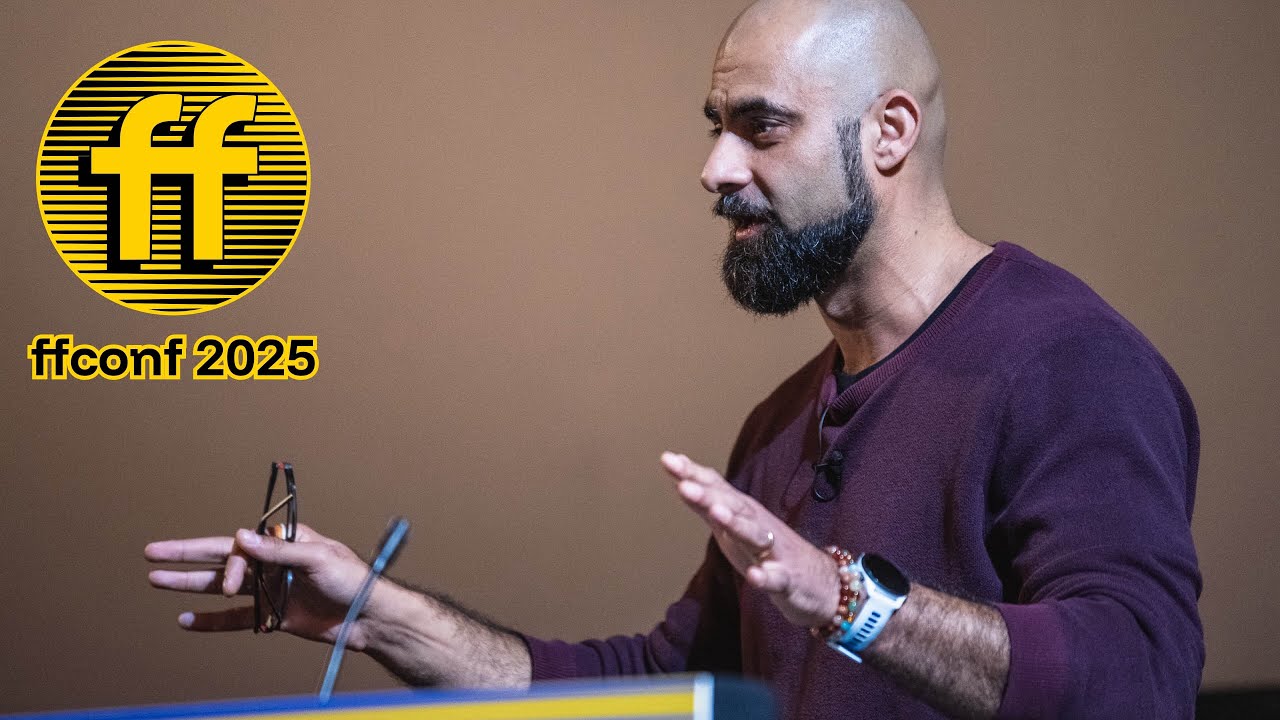
I promised the room this talk was about AI, then took the longest possible road to it — starting in Athens in 234 BC with the secret potion of the Eleusinian Mysteries, wandering through LSD, DMT and the question of what consciousness even is, before landing on the thing I actually came to argue: our democratic institutions are broken, and that broken decision-making — not the technology — is why AI frightens us. Somewhere around the halfway mark you’re meant to be thinking “what the hell is going on”. Then we find solid ground.
AI-generated summary of my talk
Jump into the talk
- 1:30 The journey begins — Athens, 234 BC
- 2:08 Initiate in the Eleusinian Mysteries
- 6:16 Hoffman, ergot and the LSD theory
- 8:19 DMT — the drug your body makes
- 10:21 Theories of consciousness
- 14:24 Unity, and the birth of Athenian democracy
- 16:25 Participatory vs representative democracy
- 19:27 Why AI really scares us
- 22:31 Digital democracy — Taiwan and Polis
- 25:34 Replaying Brexit with AI
- 35:47 Idios — don't be an idiot
The long way round
I run a foundation that helps people come together and agree on standards to decarbonise the digital sector — so I describe myself, honestly, as someone in the field of getting people to agree. Lately we’ve started using AI to help find common ground, and the results have been genuinely incredible. There’s a whole vibrant strand of academia exploring this: using AI to look past differences and make collective decisions. To explain why I think it matters, I take the audience on a deliberate detour.
So you’re an initiate in the Eleusinian Mysteries — a cult that ran for nearly 2,000 years in ancient Athens. After fasting, ritual bathing and a 14-mile pilgrimage, you enter the great hall and experience something that changes you forever. What happened inside? We don’t know. It was the fight club of antiquity — the first rule was you do not talk about it, on pain of death, and people kept the secret for two millennia not because they had to but because they wanted to. This wasn’t a fringe thing: Pythagoras, Plato, Cicero. Cicero said Athens created nothing nobler than those mysteries, “through which we became gentler”.
Drugs, and what your body is making right now
We know they drank something before the rite — a potion called the kykeon, whose only named ingredient is “sacred barley”. The chemist Albert Hoffman — the man who invented LSD by accident — co-wrote a book arguing the answer. Ergot, a fungus, grows on barley; it normally kills you horribly, but Hoffman showed you can separate the poisonous alkaloids from the hallucinogenic ones with a basic water process. His theory: in trying to get rid of the ergot, the Athenians stumbled on an LSD analogue, and that’s what they were drinking.
LSD belongs to a family of psychedelics, all cousins of serotonin. The one I’ve the most experience with is DMT — a core component of ayahuasca, which I’ve taken a lot and written about openly. What makes DMT the most interesting of the lot is that your body produces it endogenously: right now, all of you are making DMT, at the same levels as dopamine and serotonin. Your body doesn’t normally make chemicals it doesn’t need. So some researchers — and I agree with them — think DMT has something to do with consciousness.
What consciousness has to do with democracy
Patricia Churchland: “Theories of consciousness are like toothbrushes — everyone has one and no one wants to use anyone else’s.” (Swap in JavaScript frameworks and it still lands.) There are around 350 peer-reviewed theories, but they split into two camps: consciousness as an emergent property of biology, or consciousness as something more fundamental — a field, like gravity, that’s always there. The strongest hint it’s the latter is near-death experiences: people who were clinically dead, then came back, and could accurately recount who was in the room and what was said. If consciousness were just a byproduct of biology, a dead brain shouldn’t be conscious.
My current favourite is analytic idealism: one universal consciousness that buds off smaller ones, again and again — I’m a budding of a higher consciousness, my cells are buddings of mine. And the message that comes back, again and again, from spiritual teaching and psychedelic awakening alike, is the same one: unity. A sense that we’re all in this together. Now hold that thought, and remember Athens is also the birthplace of democracy. I think they’re 100% connected. Give the brightest minds of antiquity that sensation of unity, generation after generation, for 2,000 years, and you get the idea that we should govern ourselves together.
Athenian democracy was nothing like ours
Don’t confuse it with what we have. The Athenians had no elected officials and no political class. They had an assembly where roughly 30,000 could attend and 6,000 regularly did, participating directly rather than through representatives — any man who wasn’t a slave could come. The agenda was set by a council of 500, randomly selected, serving a single year and never again, so it couldn’t be captured. Political scientists call it radical democracy: the goal was never to elect someone to decide for you, it was for citizens to deliberate themselves.
What we have instead is representative democracy. We elect MPs because, supposedly, we’re not clever enough to deliberate our own issues, and then we hope, dream and pray they keep their promises. And consider how a vote physically works in the UK Parliament: the speaker shouts “division”, MPs walk into an “ayes” corridor or a “noes” corridor, someone literally counts the bodies, and the speaker declares “the ayes have it”. I’m holding a device with all the world’s knowledge in it — and that’s the best we’ve come up with for voting.
Setting the agenda, and replaying Brexit
Here’s the thing about referendums. In my foundation a working-group chair has no more power than any other member — except one: setting the agenda, deciding what gets discussed. That’s enormous. For Brexit the agenda was set for us: stay or leave, no nuance. I do this to my kids — brush your teeth before Spidey or after, you’ve got a choice, but you’re brushing your teeth either way.
So imagine replaying Brexit with today’s tools. People assume “AI in democracy” means an AI choosing for you. It’s the opposite — the AI parses the voices, fears and concerns of the people, and the people decide the preferences. The exciting part is getting rid of the political class, not the people’s voices. Instead of a fixed questionnaire (optimised for the asker, exclusionary to anyone without the right language), you just ask people to tell a story, or talk to a curious, non-judgemental LLM. I tell my team to speak their answers rather than write them — when we write we self-edit and don’t tell the truth; when we talk, all the “um”s and second-guessing carry far more nuance, and the AI is brilliant at pulling out what we meant. Cluster all those tokens and you surface preferences nobody expected. I think Brexit was really about the financial crisis — people who felt betrayed by bailouts and austerity, casting a protest vote — and a deliberative process like this could have surfaced exactly that.
It’s broken, and AI can help us fix it
After years running the Green Software Foundation — 70 member organisations agreeing standards by consensus — I’ve reached an uncomfortable realisation: we prove again and again that sustainability is a priority, and very little happens. That’s why AI scares us. Not the technology — we don’t trust our governments to enact the laws that would protect us from its impact. You can have all the brilliant solutions in the world, but if the process of making collective decisions is corrupted, nothing changes.
The field of digital democracy is vibrant, and the standout is Taiwan: a decade of nationwide deliberative process using the open-source Polis tool, where citizens actively shape policy. Their Uber rollout went through it and produced six preferences that became law. Generative social choice — there’s a seminal paper of that name — is what makes scaling the Athenian model to a whole country newly possible. It’s fragile, of course. It took a lot of LSD and thousands of years to get humans to even try democracy, the original Athenian model failed, and even our diluted representative version is under attack — there’s a real, growing movement of people, some of whom have argued it to my face, who’d prefer autocracy. But rather than give up, I say we fix it. Which brings me to the title. The Athenians had a word for someone who stayed home instead of taking part: idios, a private individual, which over Latin, French and English became our word “idiot”. So my message is simple. Don’t be an idiot.
the edge weekly, from asim.dev
Building with AI, efficiently. My essays first, plus the week's links worth your time.
Double opt-in, one-click unsubscribe, your address goes nowhere else. Or grab the RSS feed