Green Developer Relations
DevRel 2021 · London, Europe
by Asim Hussain · 22 March 2021
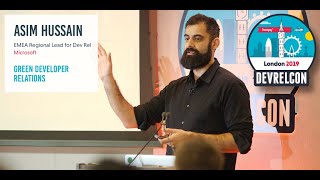
I gave this talk at DevRel 2021, fresh off becoming Microsoft’s Lead for Green Cloud Advocacy. My argument is simple: developer advocates fly far more than almost anyone, which makes us part of the problem — but also gives us an outsized lever to be part of the fix. I focus on three things you can actually do: travel, events, and your influence.
AI-generated summary of my talk
Jump into the talk
- 0:00 Who I am, and the cloth-nappy epiphany
- 3:30 Normalising the terms: carbon, 1.5°C, where we're at
- 7:40 Why advocates have outsized impact
- 8:11 Travel: the one-foot-high club and offsetting
- 14:25 Events: a carbon code of conduct, and rethinking online
- 19:25 Influence: abuse it for good, expect hecklers
- 21:33 Action: ClimateAction.tech
- 23:33 The ion-drive story: a decade, not a year
The cloth-nappy epiphany
I open with my son Micah, who was one when I gave this. A friend gave me great advice when he was born: take the nappy changes, because that’s the one-on-one time that’s just you and him. Then my wife announced we’d be using cloth nappies — which, if you’ve never used them, means you have to deal with the shit. He went eight times a day. I got very used to being covered in it, taking conference calls with it on my face.
And then it hit me. I was willing to deal with that eight times a day for the environment, and yet I could not remember a single scrum meeting, a single architecture meeting, where I’d ever put my hand up and asked, “What’s the greener option here? What does it even look like?” I’d argue endlessly over the tiniest technical issue, but never the big one I cared most about. That’s been my journey ever since — working out what green actually means for those of us in tech, and specifically in developer relations.
Travel: the one-foot-high club
Air travel is 2% of global carbon, and I know how small that sounds. But context matters: all of transportation — every car, bus, plane and boat — is 14%. Elon Musk electrifying the entire car industry is chipping at one slice of that. The 2% is our slice, and it’s worth fighting because 15% of people take 70% of the flights. Most people never fly; of those who do, most take one a year. I was on about 30 that year. A small change in us has a big effect on the total.
So: join the “one-foot-high club” — a term I borrowed, not coined — and take the train. It’s harder, pricier and slower, so don’t go for perfection. Just turn one flight into a train next year. In Europe an Interrail pass is around 250 euros for seven days; if a line’s down you simply hop another train, and you can stop in several cities and run a meetup in each, turning the journey into a tour. Whatever you do, offset your impact — but the credit market is full of con men, so only buy certified offsets: CDM, VCS, or ideally Gold Standard. With my team I asked everyone to put the carbon cost of a trip in as a line item on the request. No judging, no league table — just the act of writing the number sparks the right conversations. And if you’re going to fly, do more per trip. Is the trip worth the carbon? Not the money — the carbon.
Events: rethink online from scratch
There’s a carbon code of conduct for events — Chris Adams and others in the ClimateAction.tech community were working on it — and the bulk of an event’s footprint is attendee and speaker travel, which you can calculate and offset.
Online events get a bad rap, and I think that’s because people treat them as poor cousins of in-person ones. The mistake is asking “how do we do our in-person event online?” Online is a completely different medium — you can do completely different things. People still desperately want to connect, so design for that. My one rule: don’t forget the chat. The chat is where it’s at. Too many online events are just a livestream and a Q&A with no chat. Agile in the Ether does this brilliantly — before each session they fire off a daft request, like “go grab your favourite fridge magnet”, and everyone runs off and shows it to camera. That’s something you can only do online. Honestly, I think my talks are just an excuse for people to meet each other in the hallway track — I’m the side show, and the ticket your boss approved.
Influence, action, and the ion drive
My saying is: don’t use your influence for good, abuse your influence for good — because plenty of people are abusing theirs for the opposite. Just standing here talking about climate normalises it, so the people on the fence feel able to raise it back at their own companies. You will get hecklers and deniers — I’ve never had anyone shout “JavaScript doesn’t exist!”, but the moment I talk climate they appear. Don’t argue. Say “nice to meet you” and move on. You’re not there to convert deniers; you’re there to galvanise the people who already believe into action. And always give an action — don’t just depress everyone and leave them with nothing. Mine is ClimateAction.tech, the most helpful community I’ve ever been part of, full of people from interns to CEOs who can answer any esoteric climate question.
I close with the ion drive. I used to work at the European Space Agency, launching rockets — chemical rockets are huge power for a very short burn. An ion drive is the opposite: a tiny, constant thrust, no stronger than a sheet of paper resting on your hand, but applied for years. In the vacuum of space it eventually overtakes the rocket. As my benevolent leader put it: most people overestimate what they can do in a year and underestimate what they can do in a decade. We won’t solve this by burning ourselves out like a chemical rocket. We solve it by being an ion drive that lasts decades.
the edge weekly, from asim.dev
Building with AI, efficiently. My essays first, plus the week's links worth your time.
Double opt-in, one-click unsubscribe, your address goes nowhere else. Or grab the RSS feed