How Microsoft is Leading the Way to Sustainable Software
GOTO 2021 · Europe
by Asim Hussain · 21 June 2021
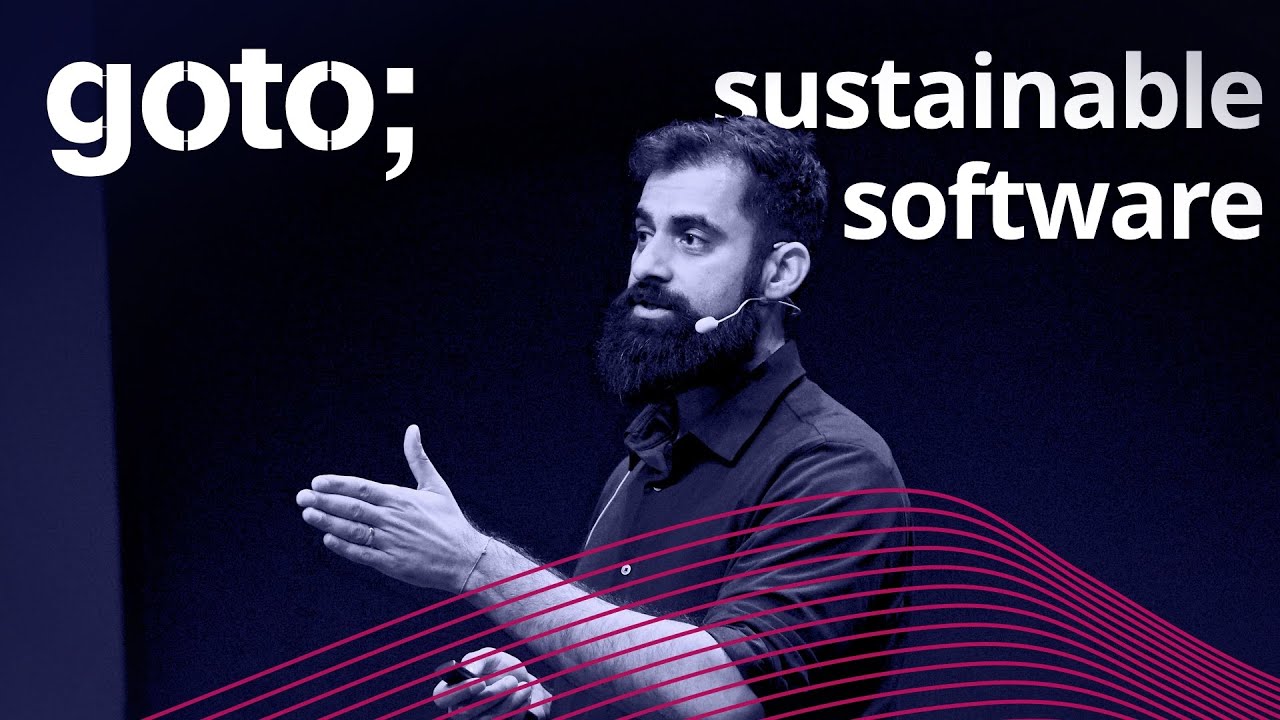
I was interviewed at GOTO 2021, back when my title was Green Cloud Advocate at Microsoft, about what green software actually is and how Microsoft was tackling it. It runs from the basic vocabulary — carbon-efficient versus carbon-aware — through the hard numbers on our industry’s footprint, into Microsoft’s net-zero pledge and the genuinely strange data-centre engineering that sits underneath it.
AI-generated summary of my talk
Jump into the talk
- 0:13 What is Green Cloud Advocacy?
- 2:23 The footprint: 1% of electricity, 14% by 2040
- 3:25 Carbon-efficient vs carbon-aware
- 4:27 Green software engineering and where to start
- 6:30 We only need a million developers
- 7:30 The black-screen myth
- 13:35 Microsoft's 4,000-strong green team
- 16:41 Carbon-neutral, the three scopes and net zero
- 18:51 Inside the data centre: circularity, immersion cooling, DNA storage
What a green application actually is
My title had the word “cloud” in it, but the work was never only about the cloud — I worked just as closely with the Windows, mobile and client teams. The thread running through all of it is one idea: a green application is a carbon-efficient one. For every gram of carbon an application is responsible for emitting into the atmosphere, you want to get the most valuable work out of it that you possibly can.
There are two ways to come at the opportunity. One is software that helps the world become more sustainable — AI that counts the trees on the planet, that sort of thing. The other, the one I spend my time on, is making sure the software itself runs more sustainably. Because our industry is both the potential solution to a lot of sustainability problems and a genuine cause of them.
The numbers, and why 1% is worth moving
The stats are worth sitting with. Data centres alone already consume around 1% of all the world’s electricity — and most electricity is still dirty, still burned out of fossil fuels. That’s predicted to climb to somewhere between 3% and 8% by the end of the decade depending on how fast we grow. Take the whole ICT sector — all the networking, all the devices, everything — and the projection is 14% of all carbon emissions by 2040. For context, the 14% the world emits from transport today is every boat, every plane, every car combined.
People hear “1%” and shrug. They shouldn’t. One percent is a huge number. We’re not the only sector working on this — agriculture, transport, energy are all looking at their own slice — and if our industry can move the needle on our 1%, that’s a number worth moving.
Carbon-efficient versus carbon-aware
This is the binary split I keep coming back to. A carbon-efficient application is one where the user has no idea anyone did anything — the behaviour, the functionality, all identical, it just emits less carbon. A carbon-aware application is one that changes behaviour to cut emissions. The example I love: a version of Windows that only charges your laptop when the wind is blowing and the sun is shining in your area, so you’re probably charging from renewable power.
For most engineers this is completely new. It isn’t something we were taught; it needs a new set of skills. That’s why we’re growing the field of green software engineering. If you want to start, head to principles.green for the Eight Principles of Green Software Engineering — I made it — or the Microsoft version at aka.ms/sse/learn, which has slightly nicer graphics and the same material. Then sign up to the newsletter at greensoftware.foundation, the newly launched Green Software Foundation, run under the Linux Foundation, which is where we’re gathering the community, the education and the certification.
We only need a million of us
Here’s the statistic I find most hopeful. There are roughly 30 million software developers in the world — a small number of people with influence over a very significant amount of our carbon emissions. And we don’t even need all 30 million. Not everyone on a team needs to be the security lead for a product to be secure. I think we only need to reach one million software engineers. Get to a million, and we can move a very big lever on sustainability.
That’s also why the black-screen question is a nice trap. People remember that old claim that if Google’s default went black it’d save enormous energy. That was true in the CRT-monitor era, when black was basically no energy and white cost energy. Now it depends entirely on the panel: on an LCD, black actually uses more energy than white; on an OLED it’s the other way round. Like everything in this space, the honest answer is “it’s complicated.”
The green team, the scopes and net zero
The most powerful thing you can do inside an organisation is grow a grassroots green team. Microsoft has a 4,000-strong internal green community with chapters in almost every country — they built a bioreactor on the Indian campus that turns canteen waste into fuel that powers the site. When 4,000 people are talking loudly about sustainability, it becomes very easy for the CEO to talk about it too.
It surprised me how ill-defined “carbon neutral” is — there’s no global definition. The Greenhouse Gas Protocol gives you three scopes: scope 1 is what you burn directly, scope 2 is the emissions from the electricity you consume, and scope 3 is your whole value chain — everything you bought to build your stuff, and everything your stuff emits once you’ve sold it. For most companies, Microsoft included, scope 3 is the biggest. “Carbon neutral” only obliges you to offset scopes 1 and 2 plus however much of scope 3 you fancy. Microsoft’s net-zero pledge counts all of it — which means every Xbox is fully accounted for, from the chemistry of making its materials to the electricity it draws from a living-room socket for its entire life.
Inside the data centre
The engineering underneath all this is the fun part. Circularity centres: a simple idea, a room in each data centre where broken servers go to be taken apart so everything reusable gets reused instead of binned. Immersion cooling: instead of using air to cool a server, you dunk it in a fluid that’s far better at carrying heat away, so the cooling burns less energy. And storing data eats a surprising amount of energy, so there’s research into alternatives to the magnetic storage we’ve leaned on for decades — including, genuinely, storing data in DNA. High-tech things, all in the pipeline.
the edge weekly, from asim.dev
Building with AI, efficiently. My essays first, plus the week's links worth your time.
Double opt-in, one-click unsubscribe, your address goes nowhere else. Or grab the RSS feed